
We turn visual data
into actionable insights

At APPLIED, we unlock real-time visibility of your shop-floor operations.

MAXIMIZE PRODUCTION EFFICIENCY –
WITH REAL-TIME OPERATIONAL VISIBILITY

Gain instant clarity into how your manual assembly lines actually run. Shop-floor video is turned into clear operational insight, revealing cycles, process steps, and deviations as they happen. Instead of reacting to reports after the fact, teams can spot inefficiencies early, understand what causes them, and take action immediately — disrupting production.

WHAT OPERATIONAL VISIBILITY UNLOCKS

STABLE FLOW

Short interruptions and hidden delays become visible, allowing teams to stabilize throughput and reduce daily firefighting.

PROCESS CONSISTENCY

Differences in how work is performed across cycles, shifts, and operators are exposed and addressed systematically.

EARLIER PROBLEM DETECTION

Deviations from standard work are identified at the moment they occur—before they escalate into defects or lost output.

From shop-floor activity to
operational insight

Performance monitoring provides a transparent view of manual assembly operations. Shop-floor video is structured into time-aligned operational data, capturing cycles, process steps, and deviations as they occur.

Operations and production teams can explore performance trends, investigate specific events, and review contextual video snippets to understand what happened—and why.

The platform operates as a self-contained system focused entirely on shop-floor visibility, providing a clear and consistent source of truth for daily operational decisions.
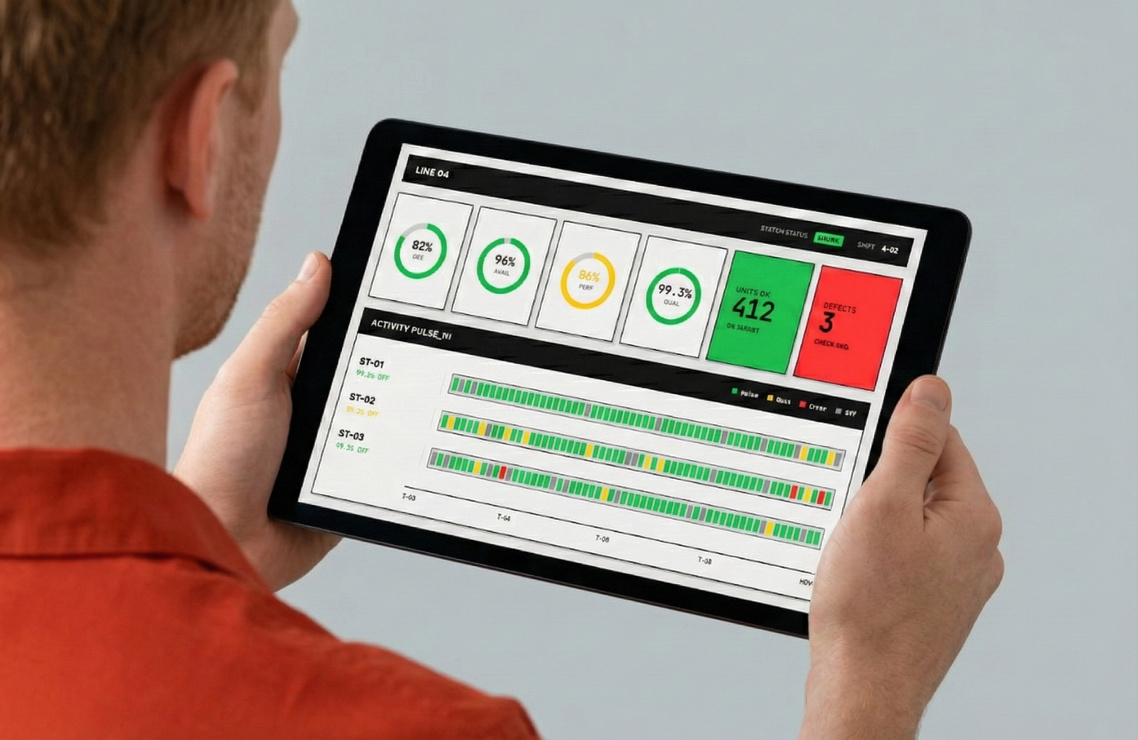

Production Dashboard

By structuring shop-floor activity into operational data, inefficiencies and improvement opportunities become visible at the point of work.

1

Capture

Relevant shop-floor activity is captured where work actually happens. Cameras observe manual operations at the workstation level, creating an objective, continuous record of cycles, task sequences, and real operating conditions.

2

Analyze

Captured activity is structured into clear, time-aligned process data. Work steps, transitions, and interruptions are organized into a consistent operational view that reflects how each cycle truly unfolds.

3

Detect

Deviations and inefficiencies stand out within the operational flow. Performance drops, interruptions, and irregular patterns can be traced back to specific moments and actions using contextual, event-linked video.

"Most inefficiencies in manual assembly originate in everyday shop-floor activities that remain unobserved and unmeasured."

Visibility is the missing link between standard work and continuous improvement.

PRIMARY SOURCES OF EFFICIENCY LOSS

Operational losses are rarely caused by single events. They accumulate silently across hundreds of small deviations during daily work.

MICRO-STOPPAGES
VERY HIGH IMPACT
Short, unplanned interruptions that repeatedly break flow and quietly erode throughput and stability.
PROCESS VARIABILITY
HIGH IMPACT
Differences in how the same task is performed across cycles, operators, and shifts introduce inconsistency and hidden inefficiencies.
STANDARD WORK DEVIATIONS
MED-HIGH IMPACT
Departures from defined best practices increase variability, rework, and downstream quality risk.
NON-VALUE-ADDED ACTIVITIES
MEDIUM IMPACT
Searching, waiting, walking, and unnecessary motions consume time without adding value—often unnoticed within active cycles.

Operating principles for modern manual assembly

We are moving from managing outcomes to understanding execution.

01

Visibility as a prerequisite

Manual work can no longer be a black box. Improvement starts where work becomes observable and measurable.

02

Standard work, verified in reality

Standard work cannot live only in documents. It must be validated by evidence from real execution.

03

From dashboards to root cause

Metrics show what happened. Context explains why it happened.

04

Flow becomes manageable

Micro-stoppages are not noise. They signal where flow breaks down.

Operational excellence depends on how work is executed — not only on how it is defined.

Operational performance is typically managed through standards, KPIs, and outcomes. While these elements are essential, they do not fully explain why performance varies from shift to shift or where losses systematically occur.

In daily operations, execution subtly drifts. Small deviations repeat every cycle, every shift, and every day. Individually they appear insignificant, but over time they accumulate into measurable losses that remain difficult to detect through traditional reporting systems.

Without direct visibility into execution, improvement efforts rely on assumptions, audits, and lagging indicators. Decisions are often made based on averages rather than the objective reality of how work is actually performed on the shop floor.

This initiative addresses that gap by making execution visible. When teams can observe where flow breaks, where standards drift, and where time is lost, they gain the power to stabilize processes, reduce reactive firefighting, and focus on real operational constraints.

The goal is to restore operational control through clarity. Visibility into execution creates a factual foundation for continuous improvement and more predictable performance.

Common questions

Deployment is designed to be lightweight and scalable. Setup time varies depending on the scope and complexity of the observed process, without requiring changes to machines or control systems.

No. The system observes work as it happens and does not interfere with machines, operators, or production flow. There is no need to stop lines, modify processes, or pause operations during deployment.

Yes. Most teams begin with a single workstation, cell, or line to validate value in real conditions. The system is designed to scale gradually, based on proven usefulness rather than upfront commitment.

No. The focus is on process execution, not individual performance. The system makes work patterns, deviations, and interruptions visible to improve processes — not to score or monitor people.

Teams gain visibility into how work actually unfolds on the shop floor: micro-stoppages, deviations from standard work, process variability, and non-value-added activities — all in time-aligned operational context.

Teams use the system to investigate disruptions, review deviations close to when they occur, and validate whether corrective actions actually improve execution. It supports daily problem-solving, not retrospective reporting.

No. The platform is intentionally standalone. It complements existing systems by focusing on execution and context — areas that traditional systems typically do not capture.

Yes. The platform can operate fully on-premise, supporting environments where data must remain inside the factory network.

No. Cloud connectivity is not required for the system to deliver value. Deployment models can be adapted to site-specific IT and security requirements.

The system works best in manual and semi-manual assembly environments where execution variability, micro-stoppages, and deviations from standard work drive hidden losses.

If daily performance is affected by small, recurring disruptions that are hard to explain with existing data, the system is likely a strong fit. A limited pilot is the fastest way to assess value in your specific context.

Relaxed Manager
PEACE OF MIND

Don't just manage the chaos. Eliminate it.

When execution becomes visible, teams stop firefighting and start improving with confidence.

Problem Resolution
MINUTES

Issues are traced back to specific moments and actions while context is still fresh.

Daily Operations
LESS FIREFIGHTING

Small deviations are detected early, before they escalate into visible disruptions.

Time to Value
IMMEDIATE VISIBILITY

Value starts with understanding execution from day one — not after months of integration.